For two decades, Wi-Fi performance was measured by a single metric: peak theoretical burst speed. Access point manufacturers slapped higher numbers on retail boxes by bonding wider channels (from 20 MHz to 80 MHz and 160 MHz) and adding spatial antennas.
In real-world environments—apartments, offices, and homes packed with smart TVs, smartphones, laptops, and dozens of IoT sensors—widening the pipe did not solve the traffic jam. Legacy Wi-Fi remained a single-lane bridge: only one device could transmit on a channel at any given instant. If a smart plug wanted to send a 50-byte ping, it seized the entire 80 MHz channel, forcing 4K video streams to wait.
Modern Wi-Fi (Wi-Fi 6/6E, Wi-Fi 7, and the emerging Wi-Fi 8 standard) rewrites the rules. Instead of chasing headline speeds on congested channels, modern Wi-Fi introduces cellular-style multi-user scheduling, aggregates multiple frequency bands simultaneously, and unlocks a massive 1,200 MHz swath of pristine 6 GHz spectrum under FCC Part 15 regulations.
01 · Generational Overview: Wi-Fi 6, 6E, 7, and 8
802.11ax (Wi-Fi 6) ──► OFDMA, Resource Units (RU), Target Wake Time, BSS Coloring802.11ax (Wi-Fi 6E) ──► Extends 802.11ax into Clean 6 GHz Spectrum (5.925–7.125 GHz)802.11be (Wi-Fi 7) ──► 320 MHz Channels, 4096-QAM, Multi-Link Operation (MLO)802.11bn (Wi-Fi 8) ──► Ultra-High Reliability (UHR), Deterministic Sub-5ms Jitter| Feature | Wi-Fi 5 (802.11ac) | Wi-Fi 6 / 6E (802.11ax) | Wi-Fi 7 (802.11be) |
|---|---|---|---|
| Bands | 5 GHz only | 2.4, 5, and 6 GHz | 2.4, 5, and 6 GHz |
| Max Channel Width | 160 MHz | 160 MHz | 320 MHz (in 6 GHz) |
| Channel Access | CSMA/CA (OFDM) | OFDMA (Multi-User RUs) | OFDMA + Multi-RU Puncturing |
| Modulation | 256-QAM | 1024-QAM (10 bits/symbol) | 4096-QAM (12 bits/symbol) |
| Spatial Streams | Up to | Up to | Up to |
| Multi-Band Aggregation | Single band per client | Single band per client | Multi-Link Operation (MLO) |
02 · OFDMA: Dividing Channels into Resource Units (RUs)
The cornerstone innovation of IEEE 802.11ax is Orthogonal Frequency Division Multiple Access (OFDMA), borrowed from cellular LTE and 5G networks.
In legacy OFDM, a 20 MHz, 40 MHz, or 80 MHz channel was monolithic. When a station transmitted, it occupied 100% of the channel’s subcarriers.
OFDMA divides the channel into smaller slices called Resource Units (RUs):
Legacy 20 MHz OFDM (Single Device at a Time):[ Station 1 (Transmitting 40-byte ping) ──────────────────────────► 100% Channel Used ]
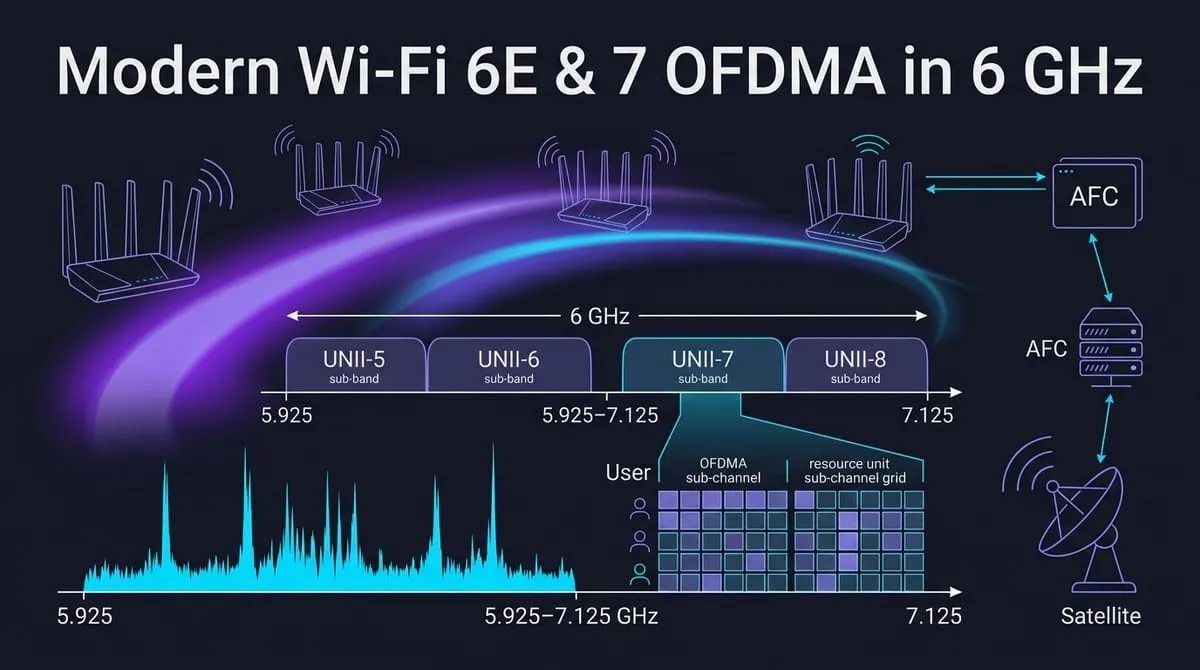
Modern 20 MHz OFDMA (Multiple Devices Simultaneously):┌────────────────┬────────────────┬────────────────┬────────────────┐│ RU 1 (26-Tone) │ RU 2 (52-Tone) │ RU 3 (52-Tone) │ RU 4 (106-Tone)││ Smart Plug │ Temp Sensor │ Doorbell │ Laptop Stream │└────────────────┴────────────────┴────────────────┴────────────────┘ - Uplink & Downlink Multi-User transmissions occur in parallel!- The 26-Tone RU: The smallest RU spans 26 subcarriers (roughly 2.0 MHz bandwidth). A single 20 MHz Wi-Fi 6 channel can support up to nine simultaneous client transmissions within the exact same time slot.
- Drastic Latency Reduction: Small IoT packets no longer wait behind high-throughput file downloads in the CSMA/CA contention queue.
03 · The 6 GHz Revolution: 1,200 MHz of Clean Spectrum
In 2020, the FCC published historic order FCC 20-51, opening 1,200 MHz of unlicensed spectrum in the 6 GHz band (5.925 to 7.125 GHz) across four designated U-NII sub-bands:
5.925 GHz 7.125 GHz ├───[ U-NII-5: 500 MHz ]───┬───[ U-NII-6: 100 MHz ]───┬───[ U-NII-7: 350 MHz ]───┬───[ U-NII-8: 250 MHz ]───┤The “Clean Slate” Rule
The 6 GHz band is completely free of legacy 802.11b, 802.11g, or 802.11a devices. Under FCC and Wi-Fi Alliance certification rules:
- No legacy beacon preambles or low-bitrate carrier protection mechanisms are permitted.
- WPA3-Personal (SAE) or Enhanced Open (OWE) is strictly mandatory. Unencrypted open networks and WPA2 are banned.
- Because every station speaks 802.11ax or 802.11be, channel efficiency is over 40% higher than equivalent channels in the 2.4 GHz or 5 GHz bands.
04 · FCC §15.407 Operating Classes: LPI vs. Standard Power AFC
Under 47 CFR §15.407, the FCC established three distinct regulatory classes for 6 GHz intentional radiators:
| Operating Class | Permitted Bands | Max Radiated Power (EIRP) | Max Power Spectral Density (PSD) | Location & AFC Requirement |
|---|---|---|---|---|
| Low Power Indoor (LPI) | U-NII-5, 6, 7, 8 (All 1,200 MHz) | 30 dBm (1 W) for 320 MHz; 24 dBm for 80 MHz | 5 dBm/MHz (AP) / -1 dBm/MHz (Client) | Indoor only; fixed AC power; integrated antennas; No AFC |
| Standard Power (SP) | U-NII-5 & U-NII-7 (850 MHz total) | 36 dBm (4 W) EIRP | 23 dBm/MHz (AP) / 17 dBm/MHz (Client) | Indoor or Outdoor; external antennas allowed; AFC Required |
| Very Low Power (VLP) | U-NII-5 & U-NII-7 | 14 dBm (25 mW) EIRP | -5 dBm/MHz | Mobile/portable devices (AR/VR headsets); No AFC |
The Power Spectral Density (PSD) Rule in LPI
In LPI mode, the FCC caps Power Spectral Density at 5 dBm/MHz, not total power:
- A 20 MHz channel is limited to EIRP.
- An 80 MHz channel reaches EIRP.
- A 320 MHz channel reaches the full 30 dBm (1 Watt EIRP) ceiling.
Automated Frequency Coordination (AFC) Realities
The 6 GHz band is shared with thousands of licensed commercial microwave point-to-point links (used by cellular backhaul, utility grids, and public safety).
To transmit at Standard Power (4 Watts EIRP indoors or outdoors), an access point must incorporate an active GPS receiver and contact an FCC-certified AFC coordinator (e.g., Broadcom, Qualcomm, or Federated Wireless):
- The AP reports its exact latitude, longitude, antenna height, and orientation to the AFC server over the internet.
- The AFC database checks the FCC Universal Licensing System (ULS) for licensed microwave links in the line-of-sight path.
- The AFC server returns a list of approved channels and permissible power levels.
- If an incumbent microwave link crosses the area, the AP is blocked from that channel.
Standard Power 6 GHz APs cannot transmit on 6 GHz until they successfully contact the AFC coordinator. If an outdoor standard-power access point loses its internet connection for more than 24 hours or fails to achieve a GPS satellite lock, FCC regulations require the radio to immediately shut down its 6 GHz transmitter.
05 · Wi-Fi 7 Innovations: 320 MHz Channels and MLO
Wi-Fi 7 (IEEE 802.11be) introduces three game-changing physical layer upgrades:
- 320 MHz Channel Width: Available exclusively in the clean 6 GHz band, doubling maximum raw channel bandwidth over Wi-Fi 6’s 160 MHz channels.
- 4096-QAM (4K-QAM): Packs 12 bits into each OFDM symbol constellation (up from 10 bits in 1024-QAM), yielding a 20% throughput boost. However, 4096-QAM demands an SNR of and an EVM of —in practice, it is only active within the same room as the AP.
- Multi-Link Operation (MLO): In traditional Wi-Fi, a client connects to one radio band at a time (2.4 GHz or 5 GHz). With Wi-Fi 7 MLO, a client establishes simultaneous radio links across multiple bands (e.g., 5 GHz + 6 GHz). Packets are dynamically steered to whichever band has a clear channel, reducing 99th-percentile jitter from 50+ ms down to sub-5ms.
06 · Field Checklist: Architecting Modern Multi-Band Wi-Fi
- Standardize on WPA3: Enable WPA3-Personal Transition Mode on 2.4/5 GHz to support legacy IoT, but enforce pure WPA3-SAE on 6 GHz.
- Enable Target Wake Time (TWT): Configure Wi-Fi 6/7 APs with TWT broadcast support to allow compatible ESP32-C6 and battery sensors to sleep for hours without losing association.
- Select 80 MHz for Enterprise 5 GHz: Avoid 160 MHz bonding in dense environments to preserve DFS channels (UNII-2A/2C) and minimize co-channel interference. Reserve 160 MHz and 320 MHz channel bonding for the uncrowded 6 GHz band.
- Ensure Clear Sky View for Outdoor 6 GHz: If installing outdoor Standard Power Wi-Fi 6E/7 access points, ensure the AP’s GPS antenna has an unobstructed view of the sky to maintain legal AFC database authorization.