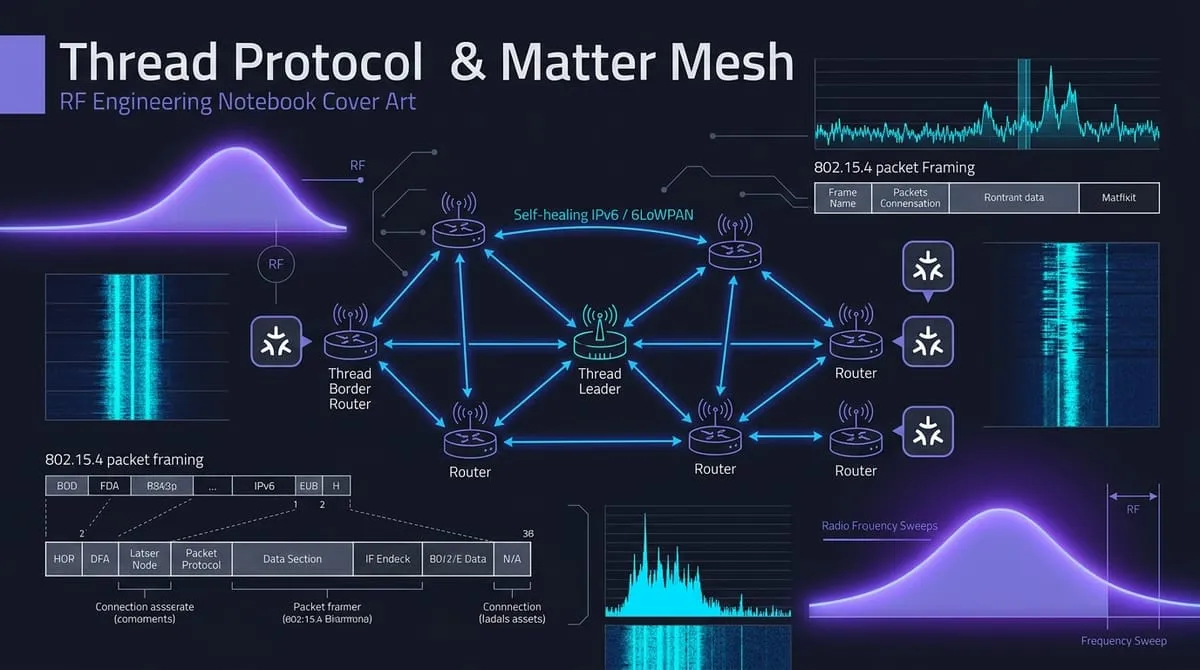
For nearly two decades, building automation relied on Zigbee and Z-Wave. While both protocols proved that low-power mesh networking was possible, they shared a fundamental flaw: they did not speak IP.
Every Zigbee and Z-Wave installation required a specialized translation gateway to convert proprietary 802.15.4 or sub-1GHz frames into TCP/IP commands that a smartphone or home server could understand. If the coordinator hardware crashed or its driver corrupted, the entire mesh halted.
Thread eliminates translation gateways entirely. Backed by Google, Apple, Nordic Semiconductor, and the Thread Group, Thread brings native IPv6 networking directly to ultra-low-power IEEE 802.15.4 silicon.
With Thread, a battery-powered radiator valve or contact sensor has its own native IPv6 address, communicates using standard UDP and CoAP datagrams, and routes traffic through redundant, self-healing border routers.
01 · The Stack Architecture: 6LoWPAN to Application
Thread is strictly a network and transport layer standard. It does not define application-layer commands like “turn on light” or “set temperature”:
┌────────────────────────────────────────────────────────┐│ Application Layer: Matter / Home Assistant / Custom UDP│├────────────────────────────────────────────────────────┤│ Transport Layer: UDP / DTLS (Datagram Transport TLS) │├────────────────────────────────────────────────────────┤│ Network Layer: IPv6 / MLE (Mesh Link Establishment) │├────────────────────────────────────────────────────────┤│ Adaptation Layer: 6LoWPAN (Header Compression/Frag) │├────────────────────────────────────────────────────────┤│ MAC & PHY Layer: IEEE 802.15.4 (2.4 GHz, 250 kbps) │└────────────────────────────────────────────────────────┘- 6LoWPAN: Standard IPv6 headers are 40 bytes long—a massive overhead for a radio frame limited to 127 total bytes. 6LoWPAN compresses IPv6 headers down to as few as 2 to 4 bytes using context-based dictionary lookups.
- UDP / CoAP: Thread avoids high-overhead TCP connection handshakes. Applications communicate using connectionless UDP datagrams and CoAP (Constrained Application Protocol).
- Matter: The unified smart home application standard developed by the Connectivity Standards Alliance (CSA). Matter sits on top of Thread, providing standardized device definitions, access controls, and multi-admin commissioning.
02 · Dynamic Roles and Self-Healing Mesh Topology
Unlike Zigbee, where a failed coordinator brings down the entire network’s commissioning and key rotation capabilities, Thread features dynamic, role-elected topology:
[ Local Wi-Fi / Ethernet Subnet ] │ ┌──────────────┴──────────────┐ ▼ ▼ [ Border Router A ] [ Border Router B ] (Apple TV / HomePod) (Home Assistant OTBR) │ │ └──────────────┬──────────────┘ ▼ [ Thread Leader ]* (Elected) │ ┌──────────────┴──────────────┐ ▼ ▼ [ Thread Router ] [ Thread Router ] (Mains Smart Plug) (Mains Wall Switch) │ │ ▼ ▼ [ Sleepy End Device ] [ Sleepy End Device ] (Door Contact Sensor) (Temperature Sensor)- Thread Routers (Mesh Extenders): Mains-powered nodes. They route packets for other nodes, advertise routing tables, and act as parents for battery endpoints. Up to 32 active routers can participate in a single mesh partition.
- The Leader: A dynamically elected router that manages router ID assignments and synchronizes network configuration. If the current Leader loses power, another Thread Router is automatically elected Leader within seconds. The mesh continues forwarding traffic without disruption.
- Sleepy End Devices (SED): Battery-powered sensors. They turn off their radios, waking periodically to poll their parent router for queued packets.
- Thread Border Routers (OTBR): Devices equipped with both an 802.15.4 radio and a Wi-Fi or Ethernet connection (such as an Apple TV 4K, HomePod Mini, Google Nest Hub, or Home Assistant yellow/USB dongle). Border routers route native IPv6 traffic between the Thread mesh and your local LAN.
Active-Active Border Router Redundancy: You can run multiple Thread Border Routers simultaneously on the same network (e.g., an Apple TV and a Home Assistant OpenThread Border Router). If someone unplugs the Apple TV, the Home Assistant border router immediately assumes the routing path. No manual failover or re-pairing is required.
03 · 6LoWPAN Addressing & Routing Mechanics
Every Thread node automatically assigns itself three distinct IPv6 addresses:
- Link-Local (
fe80::/64): Derived from the IEEE 802.15.4 64-bit Extended MAC address. Used exclusively for one-hop neighbor discovery and MLE negotiation. - Mesh-Local (
fd00::/8): A unique, non-routable prefix generated when the Thread PAN is formed. Used for end-to-end communication between any two nodes inside the Thread mesh, regardless of how many router hops separate them. - Global Unicast / Routing Prefix: Advertised by Thread Border Routers. Allows devices on your local Wi-Fi LAN to ping and communicate directly with Thread devices using standard IPv6 routing.
Distance-Vector Routing (MLE)
Routers periodically exchange Mesh Link Establishment (MLE) advertisements containing cost metrics. If a direct link between two smart plugs degrades due to a closed metal fire door, the routers automatically reroute subsequent packets through a neighboring node with better link margin.
04 · Physical Layer and Coexistence in 2.4 GHz
Thread uses the exact same underlying radio standard as 2.4 GHz Zigbee: IEEE 802.15.4 across 2405–2480 MHz (Channels 11 through 26).
Consequently, Thread is subject to the same RF physical realities and interference dynamics:
- Wi-Fi Clashes: Standard 20 MHz Wi-Fi on Channels 1, 6, and 11 can easily overpower low-power 802.15.4 frames.
- The Sweet Spot: Channel 25 (2475 MHz) sits in the spectral guard band between Wi-Fi Channel 11 and the upper band edge, making it the most reliable frequency for Thread networks.
- The Channel 26 Power Trap: Just as with Zigbee, operating Thread on Channel 26 (2480 MHz) triggers regulatory power back-offs under 47 CFR §15.205 to avoid restricted-band violations. Transceivers on Channel 26 often drop output from +10 dBm to 0 dBm. Always configure Thread to use Channel 25 or Channel 20.
| Channel | Frequency | Wi-Fi Overlap | Recommended For Thread |
|---|---|---|---|
| CH 11–14 | 2405 – 2420 MHz | Overlaps Wi-Fi Channel 1 | Avoid if Wi-Fi 1 is active |
| CH 15 | 2425 MHz | Wi-Fi 1 / 6 Guard Space | Good |
| CH 16–19 | 2430 – 2445 MHz | Overlaps Wi-Fi Channel 6 | Avoid if Wi-Fi 6 is active |
| CH 20 | 2450 MHz | Wi-Fi 6 / 11 Guard Space | Good |
| CH 21–24 | 2455 – 2470 MHz | Overlaps Wi-Fi Channel 11 | Avoid if Wi-Fi 11 is active |
| CH 25 | 2475 MHz | Above Wi-Fi Channel 11 | Best (Recommended) |
| CH 26 | 2480 MHz | FCC Restricted Band Edge | Avoid (Severe Power Throttling) |
05 · FCC Part 15 and Thread Security
Operating Thread devices in the United States falls under 47 CFR §15.247:
- Certified Intentional Radiators: Radios (such as the Nordic nRF52840, TI CC2652, or Espressif ESP32-H2) are certified under §15.247 with conducted power typically between +8 dBm and +20 dBm.
- Mandatory Link Security: Thread enforces 128-bit AES-CCM encryption across all MAC frames. In addition, commissioning uses EC-JPAKE (Elliptic Curve Password Authenticated Key Exchange) to securely pass network credentials to new devices without exposing master network keys on air.
- Part 97 Warning: Because Thread requires encrypted network framing, it cannot be legally operated under Part 97 amateur privileges. Keep Thread nodes on standard Part 15 unlicensed spectrum.
06 · Field Checklist: Deploying Thread & Matter
- Lock Channel to 25: Avoid Channel 26 power back-offs and Wi-Fi 1/6/11 interference by standardizing on Channel 25.
- Deploy Multi-Vendor Border Routers: Utilize Thread 1.3/1.4 border routers to enable cross-ecosystem credential sharing between Apple Home, Google Home, and Home Assistant.
- Maintain Router Backbone: Ensure battery-powered sleepy end devices are within range of at least two mains-powered Thread Routers for automatic failover.
- Check IPv6 Multicast: Verify that your local Wi-Fi router supports and enables mDNS / IPv6 Multicast. Thread Border Routers rely on mDNS for discovering Matter controllers.