For years, builders designing wireless sensor networks have been forced to choose between two painful extremes:
- High Speed, Zero Range (2.4 / 5 GHz Wi-Fi): Delivers 100+ Mbps and native TCP/IP, but dies after passing through two drywall partitions or fifty meters of backyard trees.
- Extreme Range, Zero Speed (LoRa / Sub-1GHz FSK): Reaches miles through dense foliage, but restricts you to fifty bytes every ten minutes with zero native IP routing.
If you wanted to stream 1080p security video from a driveway gate 400 meters away, or connect fifty irrigation controllers across an agricultural property without cellular modems, neither technology worked.
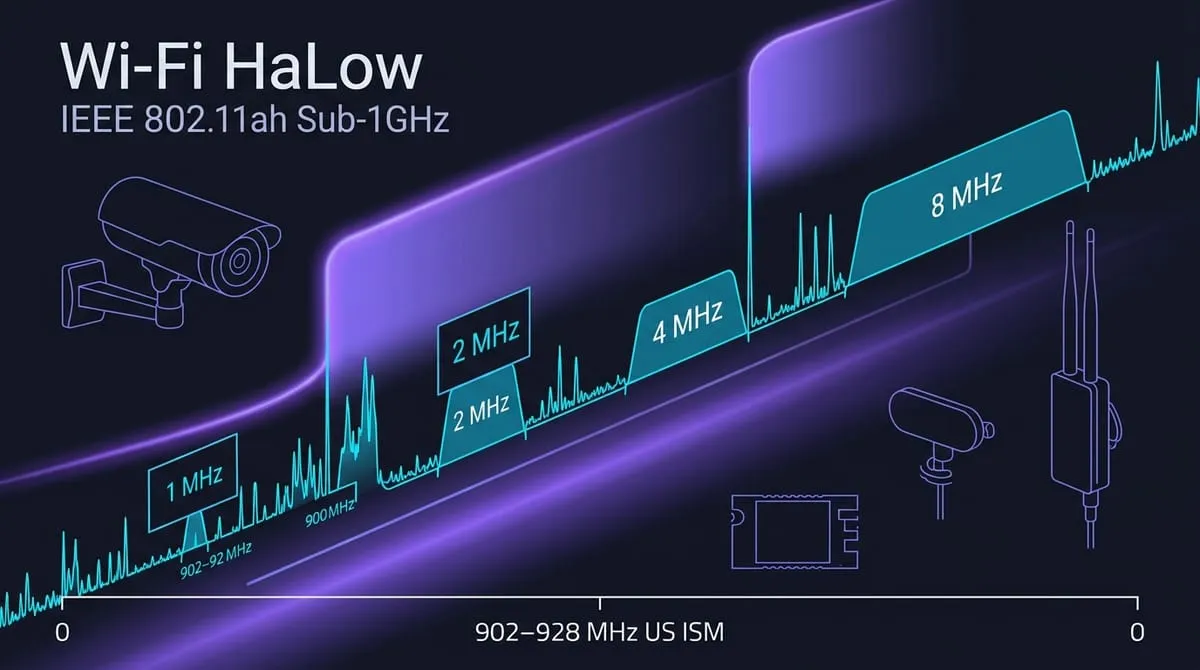
Wi-Fi HaLow (IEEE 802.11ah) bridges this gap. Standardized by the IEEE and certified by the Wi-Fi Alliance, HaLow takes the entire 802.11 Wi-Fi protocol stack—including native IPv4/IPv6, WPA3 encryption, and standard Ethernet framing—and shifts it into the 902–928 MHz sub-gigahertz ISM band.
01 · The Physical Layer: 10x Downclocked OFDM
Wi-Fi HaLow is not a proprietary spread-spectrum radio. It is fundamentally IEEE 802.11ac downclocked by a factor of 10:
| RF Parameter | Standard Wi-Fi (802.11ac/ax @ 5 GHz) | Wi-Fi HaLow (802.11ah @ 900 MHz) |
|---|---|---|
| Frequency Band | 5,150 – 5,850 MHz | 902 – 928 MHz (US ISM) |
| Channel Bandwidths | 20, 40, 80, 160 MHz | 1, 2, 4, 8, 16 MHz |
| Subcarrier Spacing | 312.5 kHz | 31.25 kHz (10x narrower) |
| OFDM Symbol Duration | 3.2 µs (+ 0.8 µs Guard Interval = 4.0 µs) | 32 µs (+ 8.0 µs Guard Interval = 40 µs) |
| Multipath Delay Spread Tolerance | Up to ~800 ns | Up to ~8,000 ns (8 µs) |
| Modulation Schemes | BPSK through 256-QAM | BPSK, QPSK, 16-QAM, 64-QAM, 256-QAM |
Why 10x Downclocking Conquers Outdoor Multipath
In traditional 2.4 GHz and 5 GHz Wi-Fi, the short 4 µs symbol duration and 800 ns guard interval make outdoor long-range links fragile. Radio reflections bouncing off barn roofs, concrete silos, or wet trees arrive microseconds late, creating inter-symbol interference (ISI) that garbles high-speed data.
Because 802.11ah stretches symbol duration to 40 µs with an 8 µs guard interval, the receiver can easily tolerate signal reflections with path delay differences up to 2.4 kilometers (1.5 miles). Combined with superior 900 MHz Fresnel zone clearance and diffraction around obstacles, HaLow delivers reliable multi-megabit connectivity where microwave Wi-Fi drops out entirely.
02 · US Channel Plan: From 1 MHz Sensor Channels to 16 MHz Video Pipes
In the United States, the 902–928 MHz band provides 26 MHz of contiguous unlicensed spectrum. The 802.11ah US channel plan supports flexible channel bonding:
902 MHz 928 MHz │ │ ├───[ 1 MHz ]─── 26 Channels (CH 1, 3 … 51) │ ├───[ 2 MHz ]─── 13 Channels (CH 2, 6 … 50) │ ├───[ 4 MHz ]─── 6 Channels (CH 8, 16 … 48: 906–926 MHz) │ ├───[ 8 MHz ]─── 3 Channels (CH 12, 28, 44: 908, 916, 924 MHz) │ └───[ 16 MHz ]── 1 Channel (CH 20: 912 MHz, 904–920) │- 1 MHz Channels: Ideal for battery-powered soil probes, environmental monitors, and utility sensors. Provides maximum receiver sensitivity (-109 dBm at MCS0 with repetition) and multi-kilometer reach.
- 2 MHz & 4 MHz Channels: The sweet spot for industrial IoT and smart agriculture. Delivers 1 to 8 Mbps real application throughput—ample bandwidth for two-way audio, telemetry, and multiple simultaneous IP camera snapshots.
- 8 MHz & 16 MHz Channels: High-throughput mode capable of 15 to 40+ Mbps. Perfect for perimeter security hubs streaming multiple continuous H.264/H.265 video feeds.
Running the 16 MHz channel (CH 20, 904–920 MHz) consumes over 60% of the entire US 900 MHz band. In rural environments, this delivers outstanding video throughput. In suburban areas with high-density smart utility meters (Itron / Landis+Gyr FHSS) or industrial RFID readers, an 8 MHz or 16 MHz channel will suffer frequent frame retransmissions. For maximum link stability, benchmark your site on a clean 2 MHz or 4 MHz channel first.
03 · Native IP vs. The Translation Gateway Nightmare
The single biggest engineering advantage of Wi-Fi HaLow over LoRaWAN or Zigbee is native Layer 2 / Layer 3 networking:
LoRaWAN Architecture:Sensor ──(LoRa PHY)──► Gateway ──(Semtech Packet Forwarder)──► ChirpStack LNS ──(MQTT)──► Node-RED ──(HTTP)──► Dashboard
Wi-Fi HaLow Architecture:Sensor ──(802.11ah Sub-1GHz)──► HaLow Access Point ──(Standard 802.3 Ethernet)──► Router / LAN Subnet- No Translation Gateways: A HaLow node gets a standard IP address via DHCP or IPv6 SLAAC.
- Direct Socket Communications: A microcontroller running an MM6108 or NRC7292 module can open raw TCP/UDP sockets, publish directly to a local Home Assistant MQTT broker (
mqtt://192.168.1.10:1883), serve an internal web dashboard via HTTP, or push video streams directly over RTSP. - Zero Cloud Dependence: You do not need to register accounts, subscribe to cloud network servers, or buy proprietary hub hardware.
04 · Power Management: Target Wake Time & Restricted Access Window
High-throughput radios are notoriously power-hungry. To enable multi-year battery life on coin-cell and single 18650 installations, 802.11ah introduces advanced MAC timing controls:
Target Wake Time (TWT)
In traditional Wi-Fi, client stations must wake up every 100–300 ms to inspect access point DTIM beacon frames. If they sleep longer, the AP drops their association.
With Target Wake Time (TWT), a HaLow sensor negotiates an agreed wake schedule with the AP:
- The node can enter deep sleep for minutes, hours, or days (current draw < 5 µA).
- The AP buffers any incoming traffic during the sleep window.
- When the timer expires, the node wakes up precisely on schedule, exchanges packets in a burst lasting less than 10 ms, and immediately returns to deep sleep without needing to perform a costly 4-way WPA3 handshake.
Restricted Access Window (RAW)
When an access point supports thousands of clients (802.11ah supports up to 8,191 associated stations per AP via hierarchical Association IDs), standard CSMA/CA contention causes devastating packet collisions.
Restricted Access Window (RAW) divides airtime into scheduled time slots assigned to specific station groups. Only stations belonging to the designated group are permitted to transmit during their slot, eliminating carrier-sensing contention storms across dense sensor deployments.
05 · FCC Part 15 Compliance: The Digital Modulation Advantage
Operating Wi-Fi HaLow in the United States is governed by 47 CFR §15.247:
Unlike narrowband LoRa (which is trapped below 500 kHz bandwidth), Wi-Fi HaLow cleanly satisfies the §15.247(a)(2) digital modulation requirements:
- Minimum 6 dB Bandwidth: §15.247(a)(2) mandates a 6 dB bandwidth of at least 500 kHz. Because the narrowest HaLow channel is 1.0 MHz, every single 802.11ah channel legally qualifies for the standalone digital modulation path.
- Conducted Power Allowance: Under §15.247(b)(3), compliant digital modulation systems are permitted up to 1.0 Watt (30 dBm) conducted transmitter power.
- Power Spectral Density (PSD): The conducted PSD limit is +8 dBm in any 3 kHz band. Because HaLow’s OFDM modulation disperses RF energy across hundreds of subcarriers over 1 MHz to 16 MHz of bandwidth, it easily complies with the +8 dBm / 3 kHz limit even when transmitting at +20 to +24 dBm conducted power.
- Antenna Gain Rules (§15.247(b)(4)): Directional antennas up to 6 dBi can be used at full conducted power (yielding up to +36 dBm / 4 Watts EIRP). Antennas with gain exceeding 6 dBi require an equal reduction in conducted transmitter power.
06 · Field Deployment Checklist
- Verify Antenna Band Coverage: Do not use standard 2.4 GHz dual-band rubber duck antennas. Wi-Fi HaLow requires dedicated 900 MHz antennas tuned to 902–928 MHz with VSWR < 1.5:1.
- Deploy Dedicated Access Points: Remember that standard Wi-Fi routers cannot hear 802.11ah. Use a dedicated sub-1GHz AP (such as Morse Micro or Alfa Network HaLow bridges) connected via PoE backhaul.
- Select Channel Width by Application:
- Battery sensors & long range: 1 MHz or 2 MHz.
- General IoT & smart farm telemetry: 2 MHz or 4 MHz.
- 1080p/4K security camera streaming: 4 MHz or 8 MHz.
- Configure WPA3-Personal: Always enforce WPA3-SAE. WPA2 is obsolete and unsupported on certified 802.11ah hardware.